Testing Sewing Machines

I went out again to test sewing machines, this time with my own materials. It made such a difference! I was really able to test what the machines could do.

Before I get into that, I highly recommend taking time to prepare you own samples to sew. I spent all the sewing time I had on Sunday prepping materials that I would sew as a test. These were not fake tests, they were real pieces that will be used in bags I am making.

I planned to perform the same tasks on an Elna 792 Pro Ex and a Janome Continental M8. Most everything I brought had two options. Mostly I got the same results from both machines. 
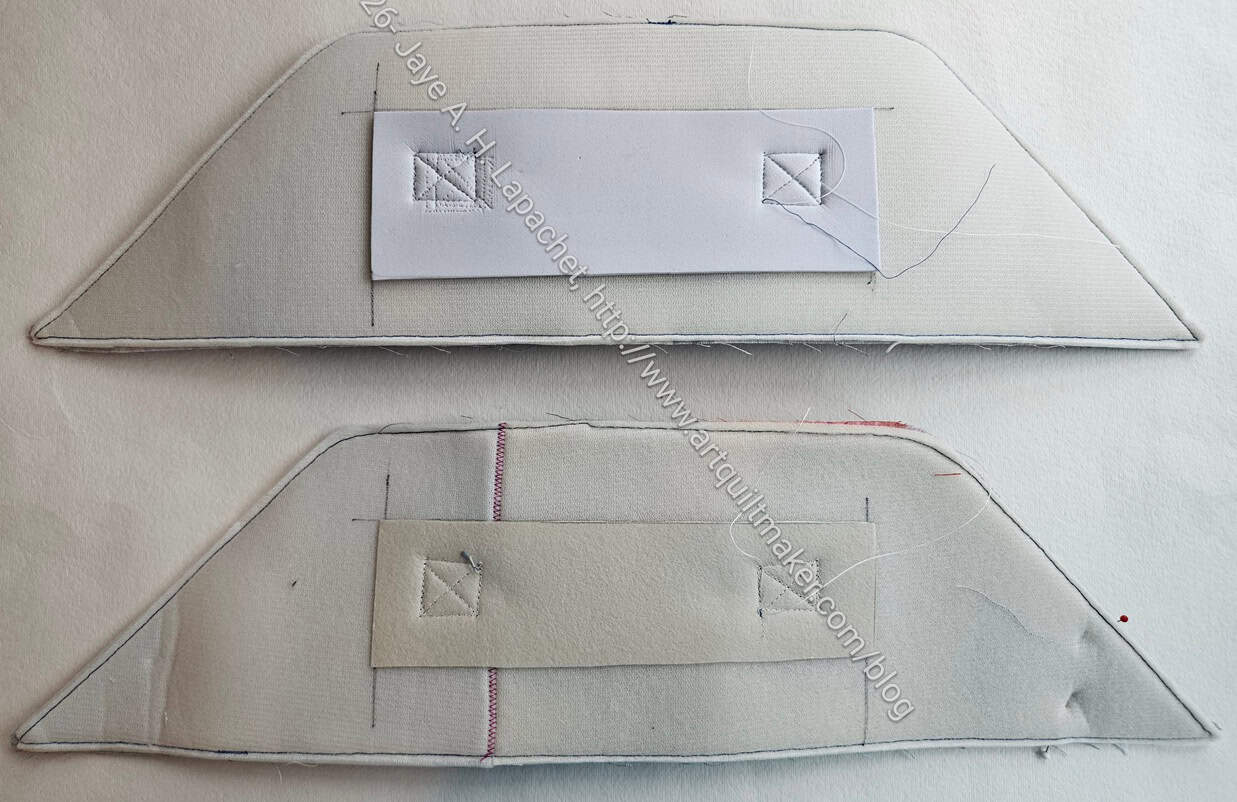
Enigma Side Panel - handle support
Enigma Side Panel – handle support

I prepped two Enigma tops, which the pattern calls the Side Panel. I wanted to test going through the handle, one of which included a layer of Decovil (bottom). The other had a layer of the Sewfisticated 2mm stick-on (top) interfacing. I wanted to see the difference in the sewing. I know the underside looks really ugly, but that is the hidden structure of the bag.

I had tried to sew the Sewfisticated 2mm stick-on interfacing on my current Enigma efforts and kept getting skipped stitches. I was annoyed, so I peeled off the Sewfisticated 2mm stick-on (top) interfacing and replaced it with Decovil. This gave me the idea to test them both out on the machines. I quickly put together the pieces for these two bags and took them with me. 

The outcome was that I learned about a new type of needle. Schmetz has a universal needle called the Super Nonstick Needles**. While I didn’t try sewing this special stabilizer with a regular needle, using one of these non-stick needles made the process very smooth. The layers were a challenge, but not the stickiness. WooHoo! I learned something new!  MaryC knows everything and she hadn’t heard of these needles either. 
I cut a foam and fabric combination using some scraps and prepped it with the MistyFuse like I have done for the past couple of Enigmas. The test I performed was using two different thread colors. The tension definitely had to be adjusted to get it perfect, but even out of the gate, the quilting looked good. I was particularly pleased that no blue thread showed on the white side.

I tested sewing one of the last steps of the Enigma pattern – the side completed panels with zipper to the bottom panel. I had some trouble the other day with the two sections slipping out of true and not getting caught in the seam. I used the HP2 foot with Acufeed, which is described as “… holds fabrics firmly in sync with the feed dogs to achieve professional results.” I found that to be true even when sewing approximately 7 layers of fabric and foam together. Technique is not to be ignored. This time I sewed from the side where I could see the previous stitches, except over the zipper. 
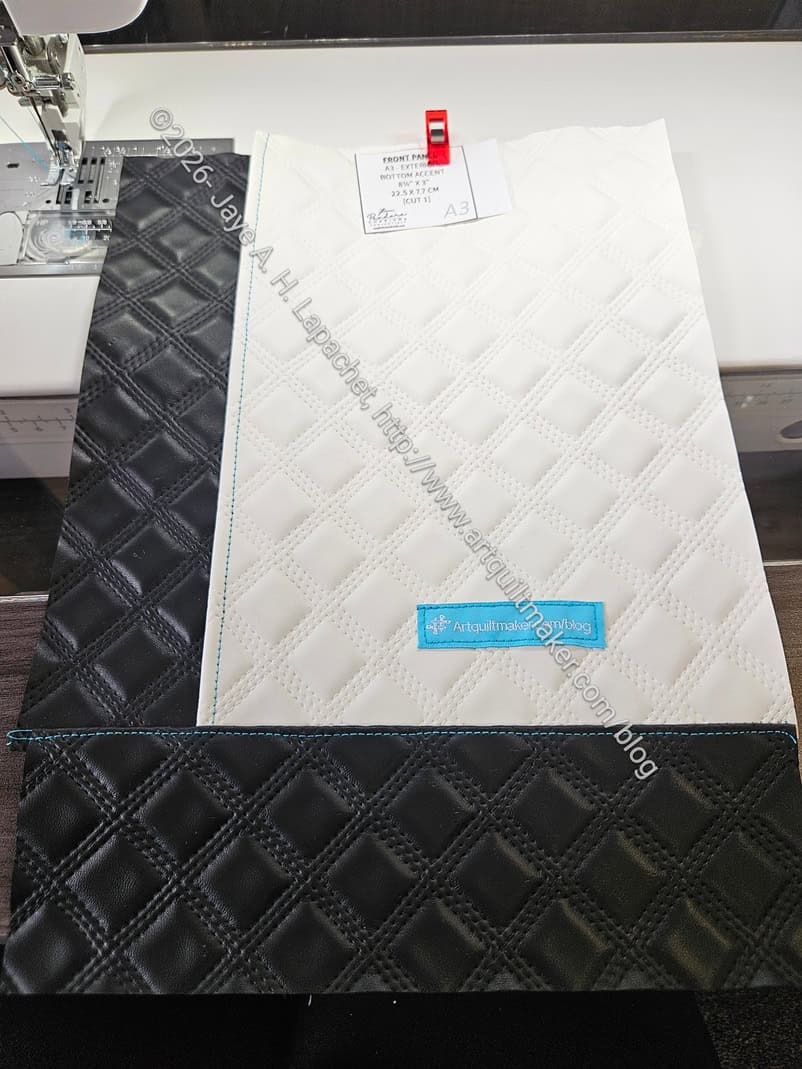
Pandora Charisma #2 front panel

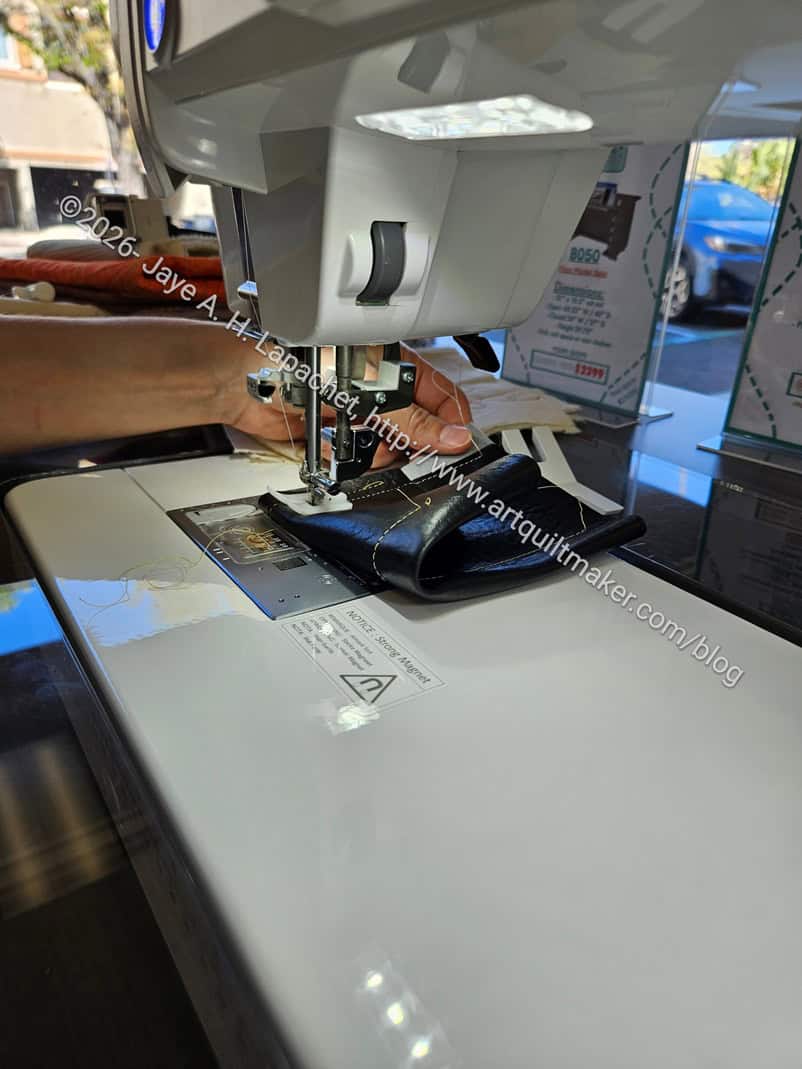
I also prepped the front panel of the second Pandora Charisma. Yes, despite the swearing, I am making another. It is not at the top of the list, but I do plan to finish it. As a result, I prepped the pieces for the front panel, because I thought that if I wanted to put the machine through a hard test, this would be it. Amazingly, I sewed the entire front panel in about a half an hour (!!!) on the machine I am considering. It was amazing. The machine had no problem with multiple layers of pleather and I could really see the difference in the stitch quality. I wasn’t even using special thread.
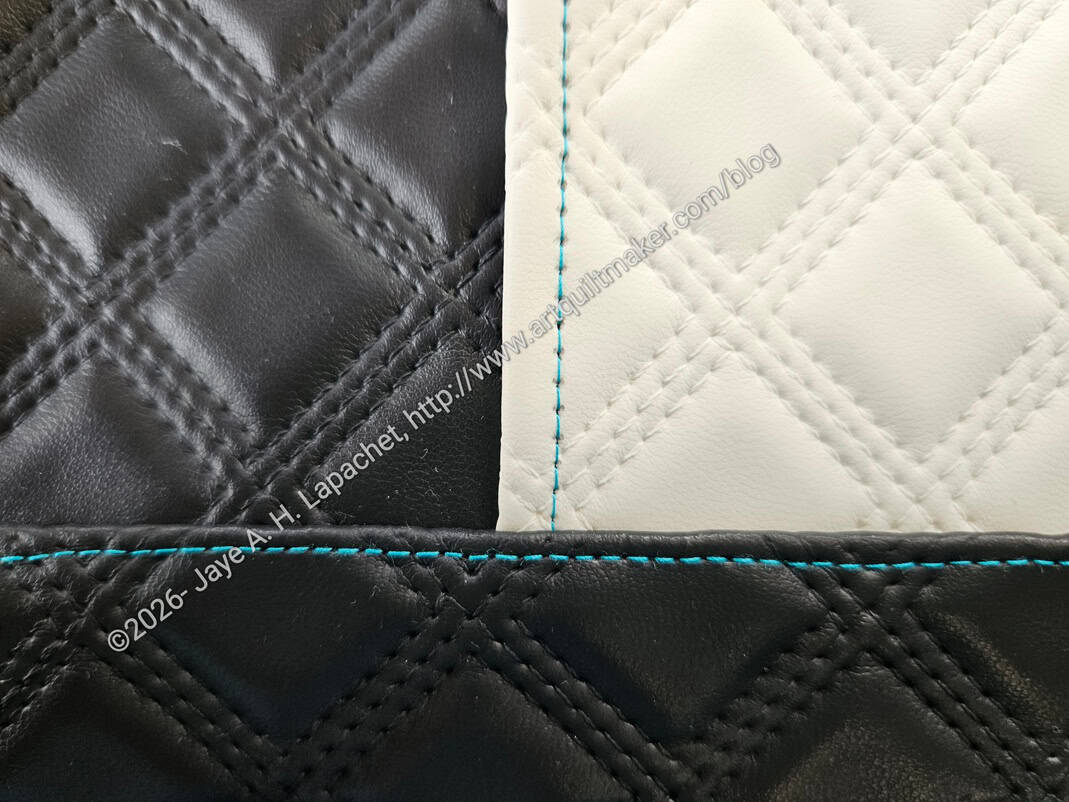
Pandora Charisma #2 front panel detail

It isn’t perfect, mostly because I am not familiar with handling the machine. Still, I was thrilled with how well I did using the pleather. I really didn’t think it was possible to have an easier time sewing through that substrate.

I know I shouldn’t compare a brand new machine to an older, well loved machine, but I was really excited by the improvement by using a machine with a more powerful motor.
The above two pictures show the differences in the stitch quality. The Pandora Charisma #1  is on the left and #2 is on the right. Both show the same front panel detail. For #1, I upped the stitch length from 2.2, which is the default, to 2.5. It is still almost impossible to see the individual stitches. The pleather is almost perforated on Pandora Charisma #1.

I did not test the Janome M8 with the Pandora Charisma. I was getting tired and wasn’t up for it. I am told that both machines are the same with different housing, so I didn’t feel I needed to do it.

We’ll see what happens. I am inclined to buy one of these machines. I’ll have to wait and see.


**Obviously, you should shop at local quilt shops and small businesses. However, if you are too busy or can’t find what you need there, I use Amazon affiliate links and may be paid for your purchase of an item when you click on an item’s link in my post. There is no additional cost to you for clicking or purchasing items I recommend. I appreciate your clicks and purchases as it helps support this website.
Sewing Machine Shopping

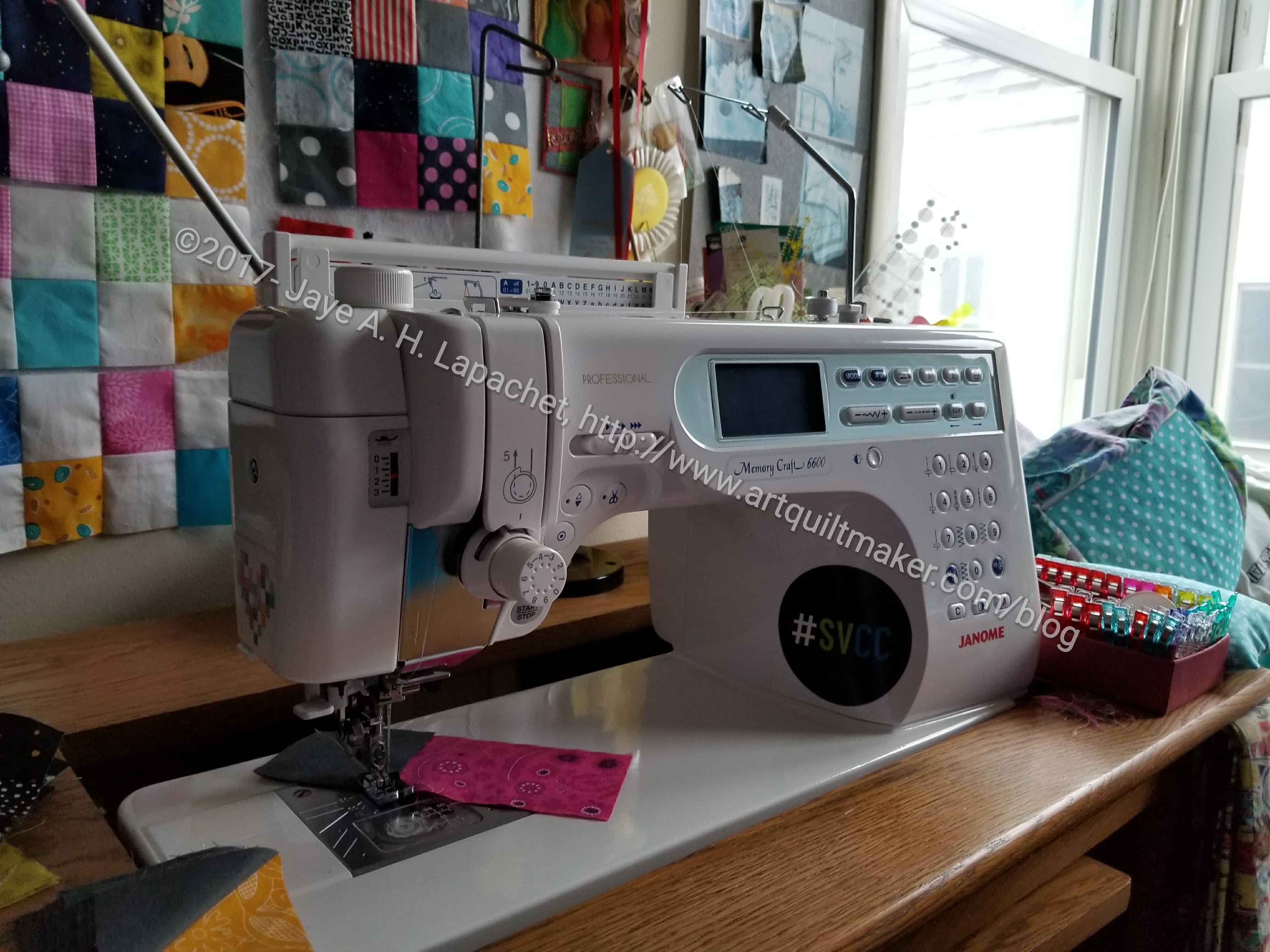
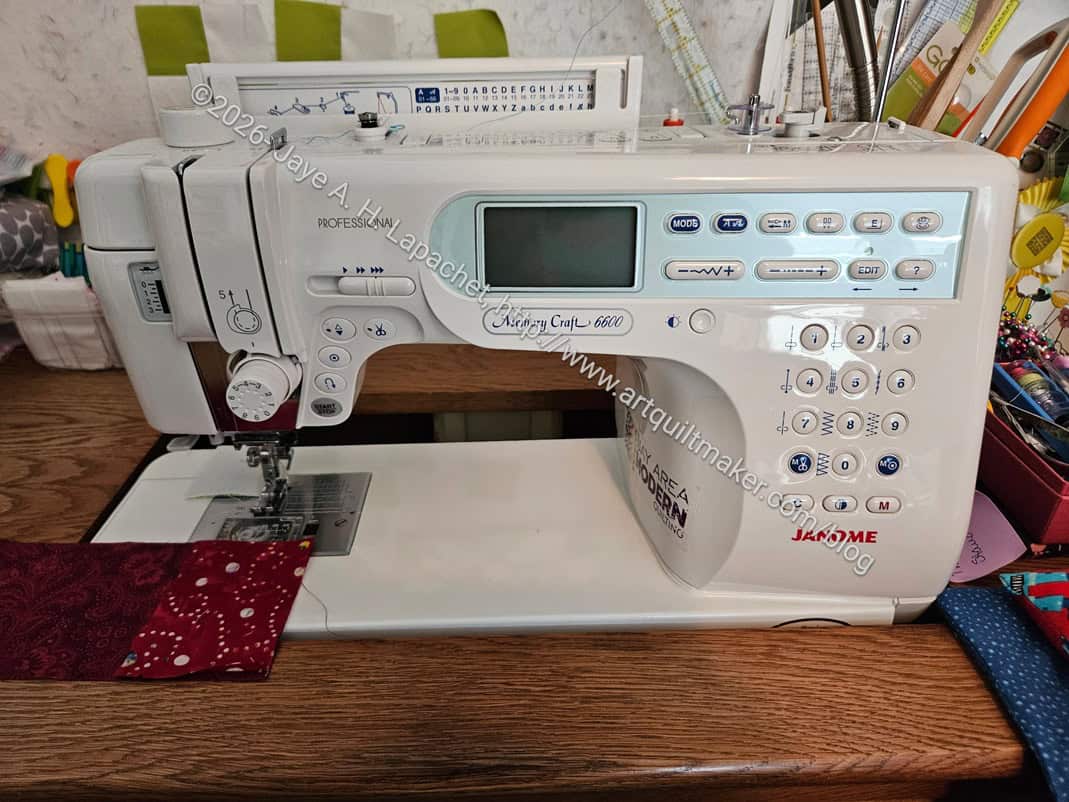
Janome 6600
Janome 6600

After finishing the Pandora Charisma and thinking about what I want to do next time, I decided to go sewing machine shopping. Kind of an extreme reaction, I know, but my machine has been bugging me. The stitch length has a problem that seems to only be a problem for me. Making the Pandora Charisma made the problem worse. 

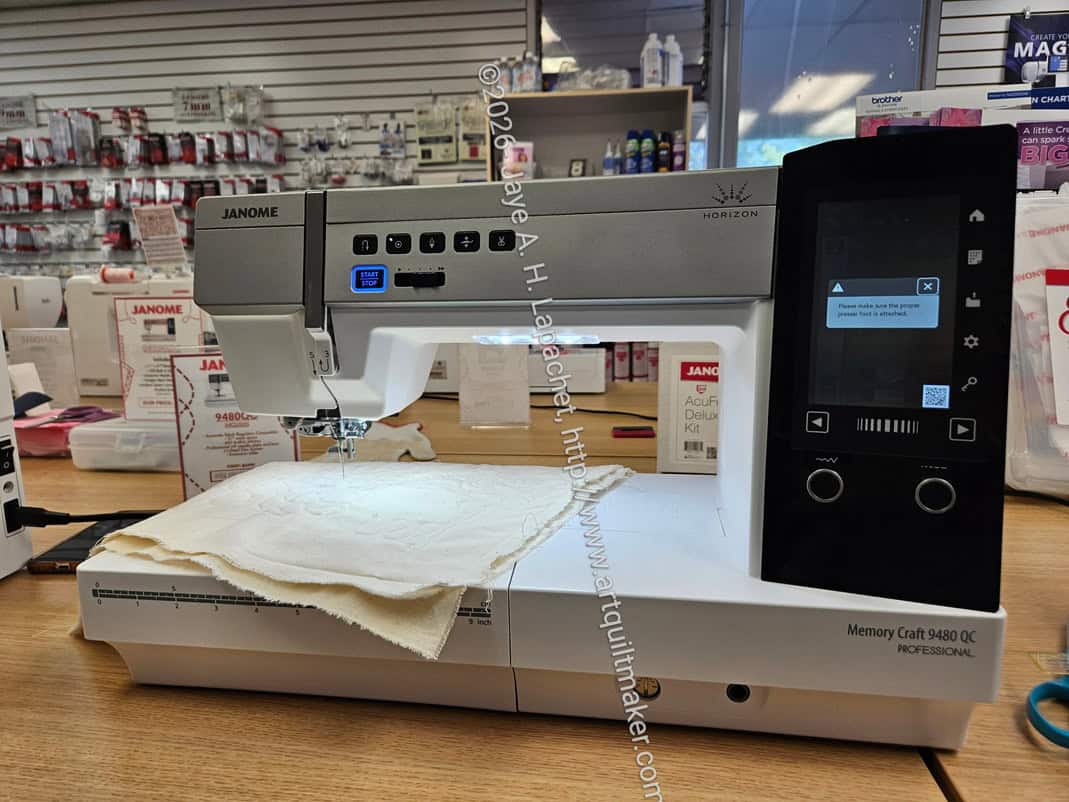
I have been out twice and have looked at 3 different machines, the Elna 792 Pro, the Janome Memory Craft 9480 QC and the Janome 6700, which is the newer model of the machine I have now.

The Janome 6700 is similar to the machine I have now. I looked at this machine on my first outing. It doesn’t have Accufeed capability, so I would basically be buying better stitches. I probably won’t buy this machine.

Yesterday, I went back to the same shop and looked at the Elna 792 Pro again and the Janome Memory Craft 9480 QC for the first time. Laura came with me to provide moral support. I am assured that the Elna 792 Pro is the exact same machine as the Janome M8, which I went in to look at. The differences are white vs. grey color of machine and the AccuSpark app. The Elna does not use the AccuSpark app. I probably wouldn’t think to use it anyway.

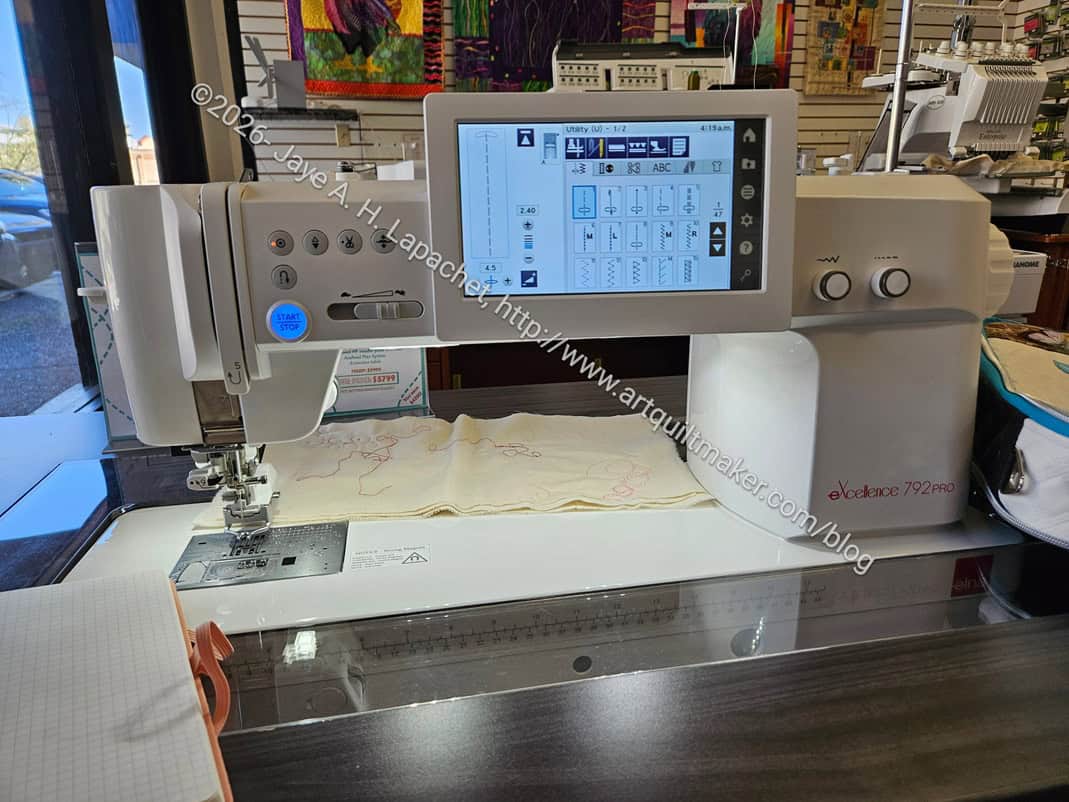
Elna 792 Pro
Elna 792 Pro

The Elna has 13.5 inches of throat space and is a flat bed machine. My current machine has 10 inches and is also a flat bed machine.  I can tell the difference. It feels very spacious under the throat.A flat bed machine means that there is more space under the needle for the engineering/motor/mechanical bits. I learned that today, which I thought was interesting. 

Sewing pleather on the Elna 792 Pro

There is a separate bobbin winder, which I enjoy now on my Janome MC 6600. The added bonus is there is a thread cutter that is part of the bobbin winder. I didn’t bring my own materials to sew. I meant to, but never got around to it. A, the person helping me, brought out some pleather and I was able to sew on it.  The machine doesn’t come with a Teflon foot, but I can buy a Teflon foot and throat plate combination pack. It means that when sewing vinyl or pleather, both top and bottom will be slippery. We really put the machine through its paces with the pleather. It sewed a really nice stitch even with about 5 layers of pleather. The key is to keep the foot level. Someone told me that I should not be sewing fabric thicknesses that force the foot not to be level and I should never use a hump jumper**. ‘A’ said that that was why the machine came with a hump jumper. That made me feel better since I use my hump jumper all the time.

The machine comes with a lot of feet, though not all that I think I would want. It also comes with 3 stitch plates, which are SOOOO easy to change. What a difference between trying to unscrew the plate I have  now. The stitch plates on the Elna automatically lift up when the button is pressed. The machine is very smart. It has a plate sensor so you can’t move the needle into a position that is incompatible with the stitch plate. 

I tried a hand stitch ‘look’ stitch and that was amazing! It really looked good and I can see using as a top stitching. 

‘A’ said that this Elna (or the Janome M8) is the strongest home sewing machine they sell without getting into industrial machines. I do not want an industrial machine. I think I can rent one at a local sewing store if I need one. 

Janome 9480 QC
Janome 9480 QC

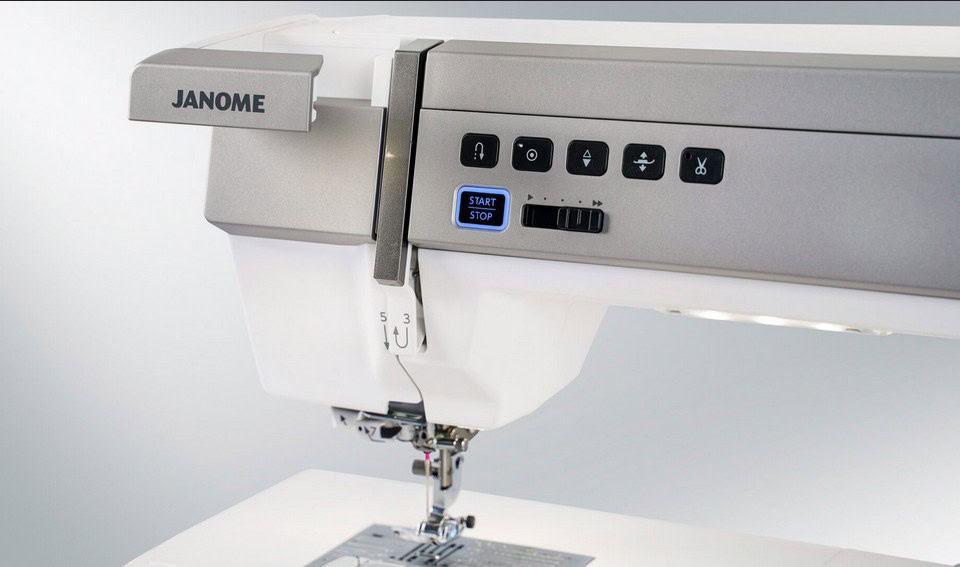
The Janome Memory Craft 9480 QC was the second machine I looked at yesterday. The motor isn’t as powerful as the Elna 792 Pro and there is an extra charge for the stitch regulator. It has 11 inches of throat space and I could tell the difference when compared with the Elna.

Janome 9480 QC-light

A bonus is that this machine has a pull out light that provides even more light than what is given in the throat space. There is no separate bobbin winder on this machine so I would have to un-thread, wind the bobbin and re-thread. Not earth shattering, but not ideal either.

The stitch plate is not electric, but pops off easier than the machine I have now. No screws required. This machine has the same accessories. It only has a horizontal thread stand, though a vertical option is available at an extra price. 

Neither machine uses the AccuSpark app. I probably wouldn’t use it though you never know. 

I have a lot to think about! What machine do you have? What is the best feature?


**Obviously, you should shop at local quilt shops and small businesses. However, if you are too busy or can’t find what you need there, I use Amazon affiliate links and may be paid for your purchase of an item when you click on an item’s link in my post. There is no additional cost to you for clicking or purchasing items I recommend. I appreciate your clicks and purchases as it helps support this website.
Misbehaving Machine

I talked about the poor stitch quality on my main machine the other day. I did some investigation while I was away, sort of by accident. 

Backup machine flush in cabinet

I used my travel machine while in Portland. By comparing the two I found some very interesting behavior to be taking place with my regular machine.  I found the stitch quality on my travel machine to be no problem. Going over thick sections of bags and hems was also no problem. The travel machine did not suck the fabric down into the workings.  

Janome 6600
Janome 6600

I got back to working my 6600 hard when I got home. I found that I had to change the stitch length to get the same sized stitch as the default on my travel machine. As I worked on the Colorblock Chubby Charmer, I found that the stitch length didn’t really change when I got some thickness under the foot. 

I had this machine serviced recently and it got the all clear from Angie. However, I am not happy with what I am experiencing. I need a good stitch quality. Perhaps I will try making the same Chubby Charmer on the smaller machine and see how the stitch does? I can’t complain too much about the 6600. I bought it used at least 15 years ago and have been working it hard ever since. I didn’t think machine wore out, but maybe they do? I guess we’ll see what comes next.

Trying Out a Juki

I am thinking of buying a new sewing machine.

First, I am going to get my 6600 serviced, of course, but I have had it for ~8 years and I have put in a lot of hours on the machine. Kelly had it before me for ~7 years. It should last longer.  It is struggling, however, with the thickness of the materials I use when I make bags. Since I don’t think I will stop making bags, I need to see what I can do to fix this situation.

Cyndi offered me the loan of her Juki to try out. While this searching process won’t be quick, I decided to take Cyndi up on her offer while I had the time and the opportunity.

I have long admired the ease with which Sara, of Sew Sweetness, navigates her bag making on her videos. I am sure she doesn’t put the swearing and problems in the videos, so I have to remember that no machine is a panacea.

This won’t be a full on review. You can find those in other places on the web. I am just going to share my impressions.

Cyndi's Juki TL-12QVP
Cyndi’s Juki TL-12QVP

Since I had a bag on which to work rather than just a quilt, I spent Saturday trying out Cyndi’s Juki. A lot of people in the guild have Jukis and love them. I have heard a few people have gotten lemons. However, I think that most people love them, but a few people struggle with various problems.

The machine is a straight stitch only machine, so that is something to consider. I do need to satin stitch/zigzag for machine applique’ and some zigzag for making bags. I also like using the stitch letters on my Janome.

Juki-zipper tab
Juki-zipper tab

First of all, I really liked the stitch quality on thick lumps of fabric. I also noticed that the foot stayed relatively even while sewing a zipper tab. This doesn’t happen on my Janome. The foot is at a big angle and I know that makes the machine work harder and more poorly, which, in turn, reduces the quality of the stitch.

I had a problem with sewing on zipper tabs on the Superbloom. The problem was on the bottom and we couldn’t figure it out. I didn’t think it had anything to do with the number of layers of fabric since I sewed the zipper tab with no problem. I had to do some ripping and left those pieces to work on at home. That is something I’ll need to ask about if I decide on a Juki.

My 6600 has a large harp, but the Juki’s harp was higher and I noticed that I had more space to maneuver. It was really nice to have some extra vertical space.

Juki - Not 1/4 inch
Juki – Not 1/4 inch

One of the things I have been thinking about is the foot. I like the idea of sometimes being able to use the edge of the foot as a guide without having to use a foot with the lip I normally use. In this case, Cyndi’s foot was not exactly 1/4″, so I couldn’t try that out. She said Juki does have a quarter inch foot. They also have a 1/4 inch foot with a lip, which would be great.

I was a little surprised by the complicated threading the Juki requires. I was turned off by the need to oil the machine. Cyndi said it was easy, but I don’t know.

Other than the above, I haven’t looked at any other features or reviews. I’ll gather information and we’ll see what happens.

Sewing on another Machine

Mary's Crescendo
Mary’s Crescendo

I took some materials for a couple of ByAnnie project bags with me to sew while I was visiting Mary. I don’t often travel with my machine when I got to Portland, because I don’t want to bring any more stuff than I already am. Mary was kind enough to let me use her Crescendo.

I wasn’t excited about using a different machine and a different brand. It can be hard to create different habits or not use the habits to which I have become accustomed.

Using the laser
Using the laser

I was amazed at how easy the machine quilting was on Mary’s machine. As I mentioned before, I used the button to move the presser foot up and down and I used the automatic cutter. While the pieces I was quilting were not large, they seemed to go really quickly. No drama, no problem. Actually, I barely had to do anything. Yes, I had to guide the fabric, but that was it. I used a light touch and it felt like the machine was doing everything. At one point I used the laser to guide the needle. I didn’t really need the laser since I was following the side of the foot, but it was fun to try it out.

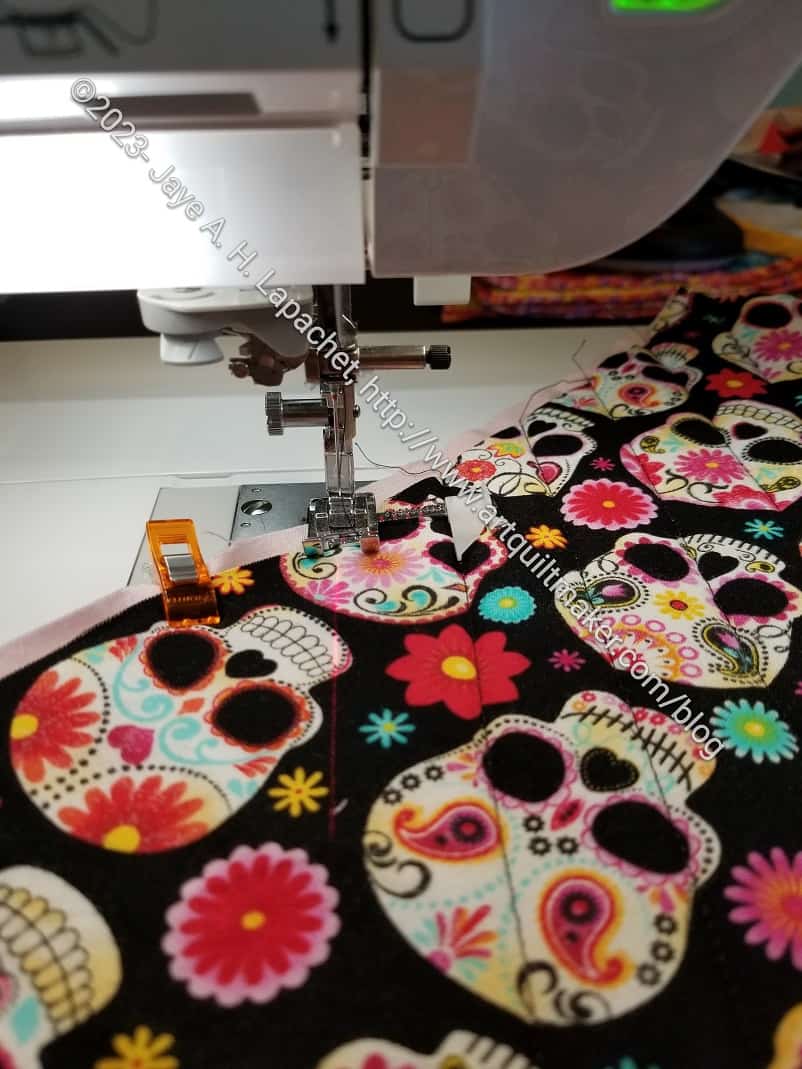
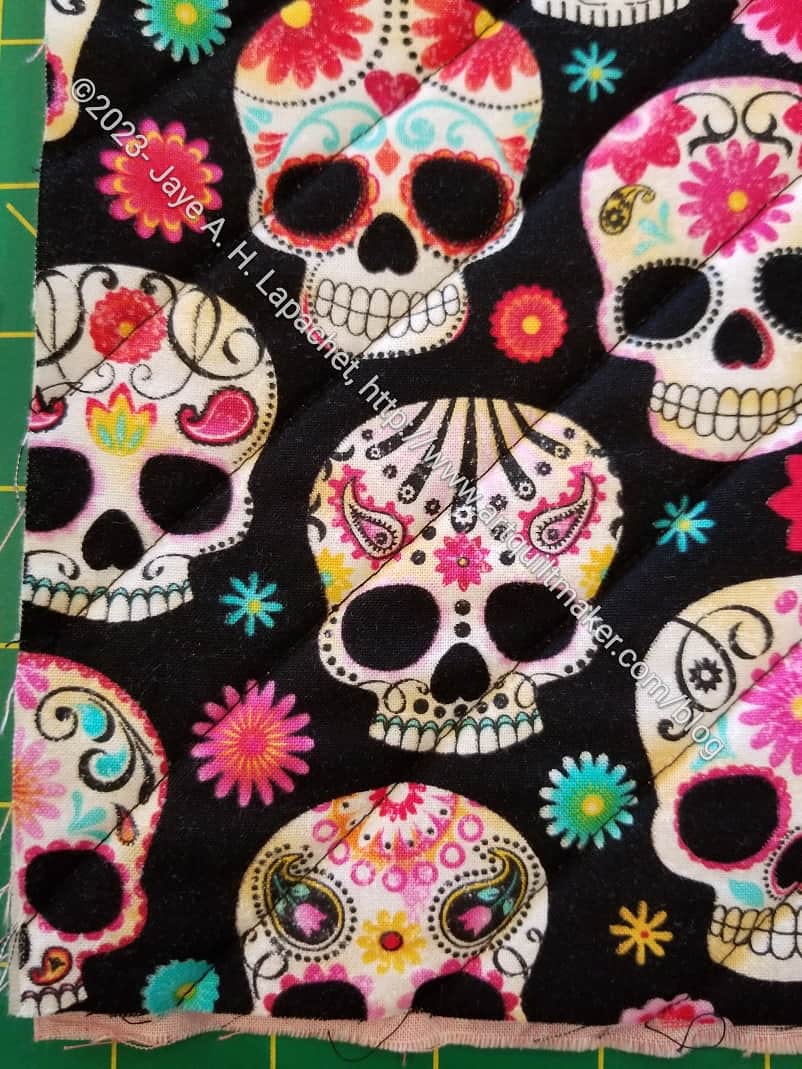
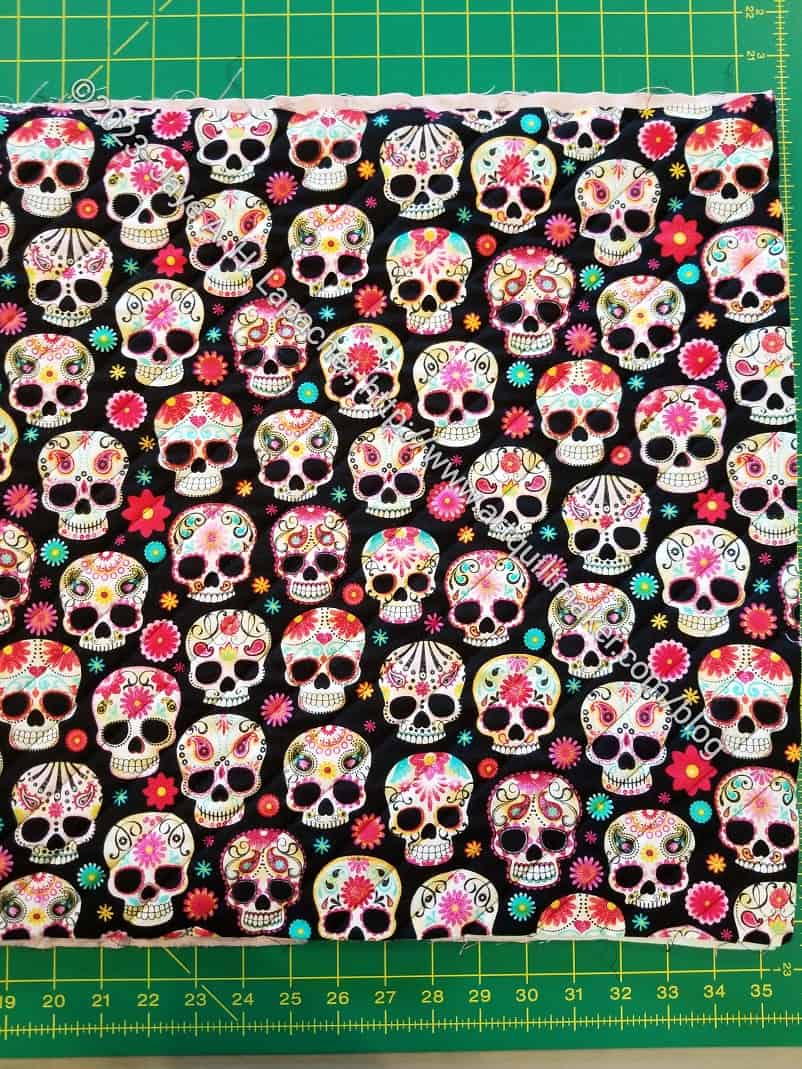
Quilted lines in skulls

I didn’t worry about doing fancy machine quilting; I just did some straight lines and used a foot with an attachment that means about an inch from the previous line. You can see the white guide on the right in the photo above.

I am pleased with the way the quilting came out and am also pleased with the process in general. Now all I need to do is put the bags together.

Bag piece
Bag piece

No Service Lint Blob

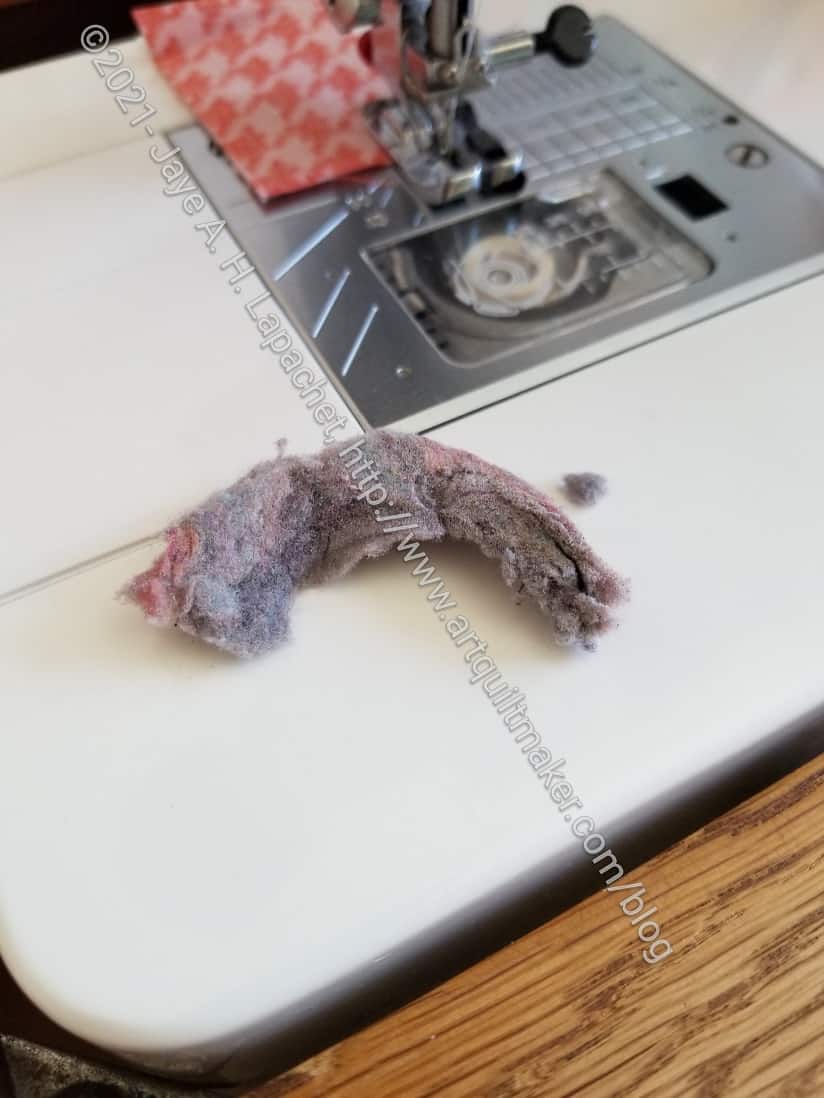
My machine was running badly and it was loud. This was well deserved punishment for me, because I didn’t take it for its usual spa service last May.

No service lint blob

When the stitch quality started to deteriorate, I decided it was time to, at least, clean it out. I took off the sole plate and the bobbin case and cleaned out any lint I could find and reach. It was actually quite a lot, I am ashamed to say.

I am planning to take it in. I have to make an appointment. I’ll do the two machines in tandem with my 6600 going while I am on a short trip DH has to take.

Lesson: clean out your machine even if you can’t get it serviced.

Rotary Even Foot :(

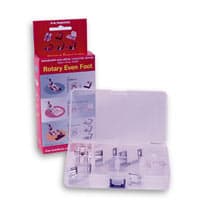
Janome Rotary Even Foot

I had high hopes for the foot when I started to work on the covers for our dining room table leaves. I bought this foot when it came out new for my MC 9000.

Based on my reading, I thought this foot would help me put the binding on the covers evenly. I have never been adept at machine binding, but this tool seemed like it would solve my problems.

I started to worry, however, when I watched a few of the videos available on using the foot.  The videos I watched (4-5) did not show how miter or go around corners. The videos on attaching binding did not show how to start the foot and the binding nor did they say whether you needed extra at the end.  None of the videos showed a real project, only samples. None of the videos or the written directions talked about adjusting the pressure of the foot. I felt like the tractor foot wasn’t all the way down the whole time I was using it. I checked repeatedly and decided to leave it rather than getting out the machine manual.

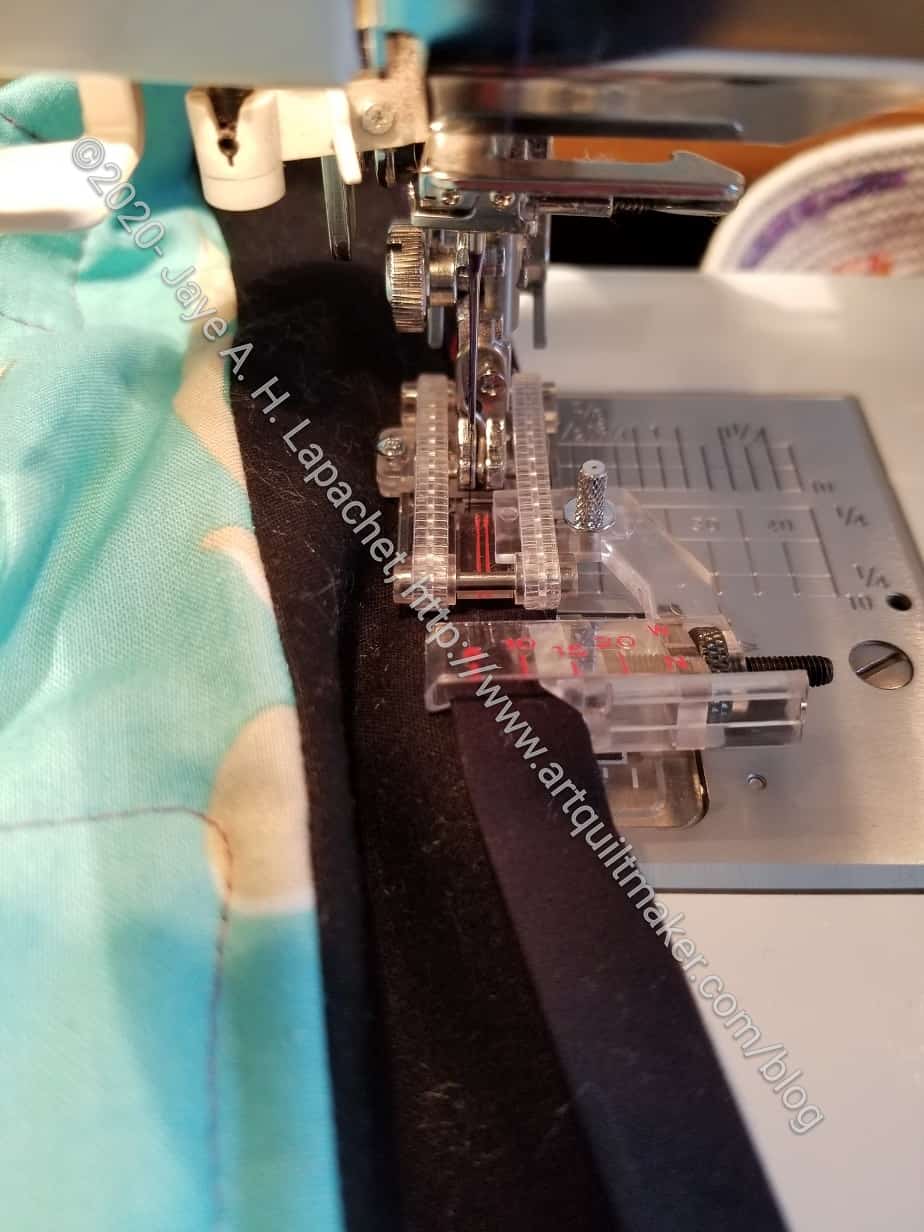
Rotary Even Foot applying binding

I tried it anyway and determined that the foot might work well for machine quilting, but that my suspicions were true. The foot did not work well for applying the binding. It was hard to get the beginning of the quilted piece into the foot (not well documented in the videos or written directions). Once I was able to get the piece in, I found that the stitching line was nowhere near the edge of the binding, leaving a flap of fabric.  Once I fixed that, I found that the binding was not being applied evenly. Something was happening on the bottom of the piece (shifting due to operator error or machine error or foot error), so there were sections of the binding that were not sewed down.

One of the things I figured out was that I can probably use the tractor foot without the binding or hemming attachment for machine quilting.  One of my issues with machine quilting is seeing the stitch line while I am stitching. I think with this foot I would be able to see the stitching.

Sigh. I ended up doing a normal machine binding and decided not to care as long as it looked relatively decent.

Sewing Machine Angst

I seriously DO NOT want to collect sewing machines. To me, sewing machines are a tool that I plan to use. That being said, I do have my great grandmother’s Necchi, which I had repaired, but only used a few times as a sewing machine. It is currently being used as a night table* in my bedroom. I don’t really have a place to set it up, so, for now, it is a night table.

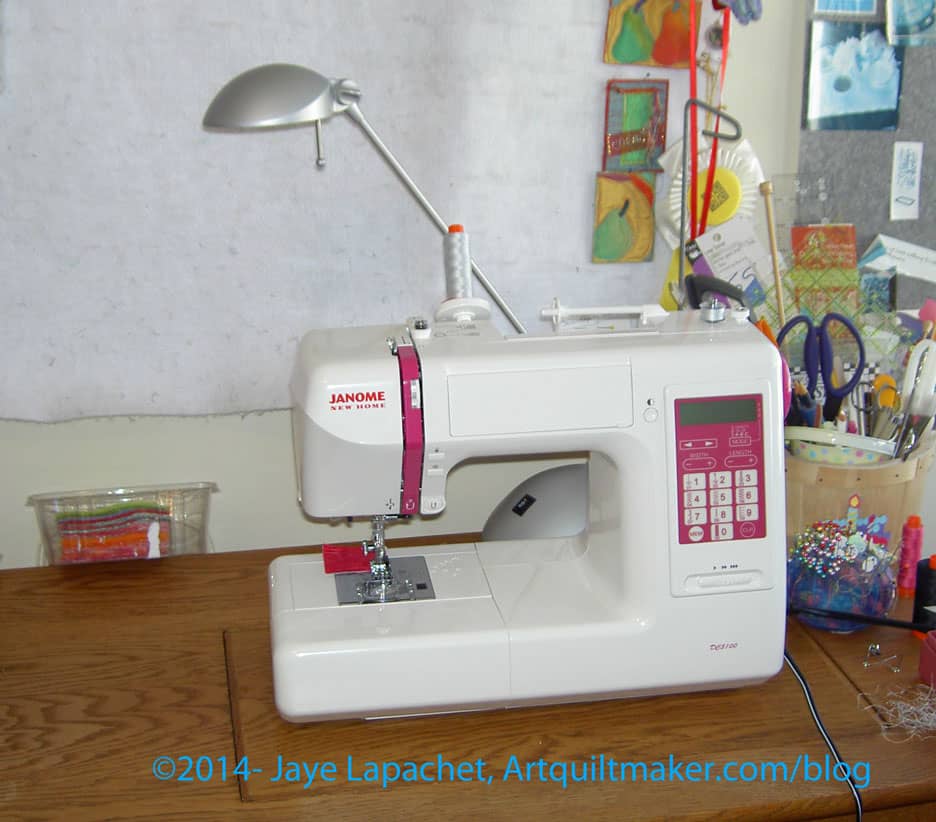
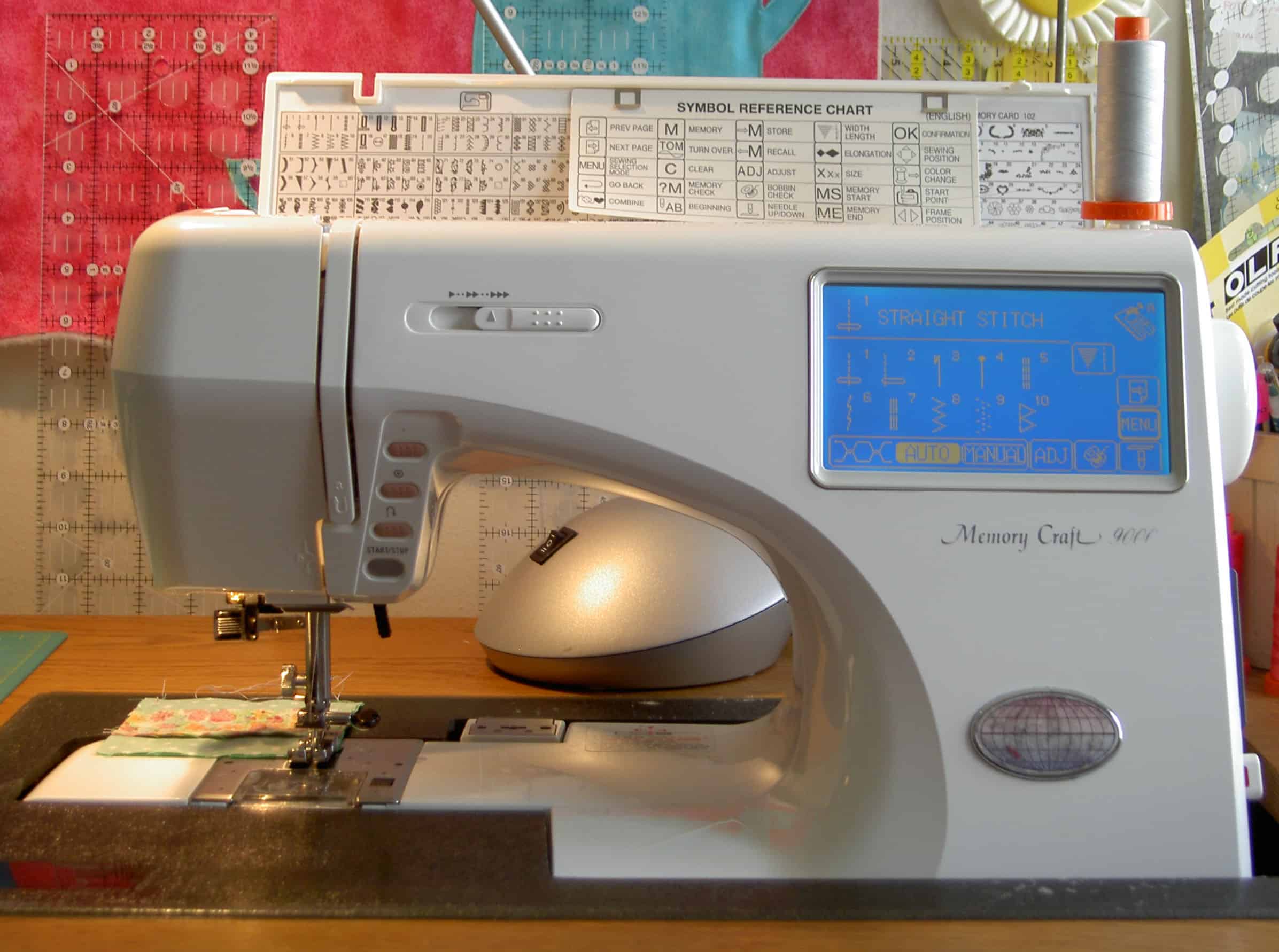
Janome DC5100
Janome DC5100

I also have the DC5100, which I purchased as an upgrade to take to classes. I had the Janome Jem for awhile and really liked it. Great stitch quality, easy to use, a few more than basic stitches. Very workable for classes. Still, I wanted a little more, so I bought this one, which I used on and off as my main machine while struggling with problems with the 9k.

Janome 9K back from the shop - June 2016
Janome 9K back from the shop – June 2016

I also have a Janome 9000, which was the first Janome electronic machine. It is 20 years; I bought it the year before the YM was born thinking it would last me forever. I couldn’t even begin to conceive of the fabulous features new machines would come out with when I bought it. Also, I didn’t count on wear and tear. As you know from recent posts, it is showing its age.

Janome 6600
Janome 6600

My friend has moved to Scotland, mostly. She left last week, but will be back later this week to clear up a few things. She suggested that I buy her Janome 6600. I really wasn’t in the market for a new machine except that I sort of am. I need something that will go through multiple layers of bag construction (remember my fight with the Boxcar Tote?) and generally be a workhorse. It isn’t the fancy machine that is the Janome 15k, but it is a new machine (to me) and has a lot of good features I want. She also will give me a payment plan and is allowing me to try it out.

I brought it home and sat it on my floor for a week. When I realized I needed to decide in a week, I knew I needed to get on it. I started to prepare to sew after Sew Day on Saturday and decided that I wasn’t allowed to sew until I set up the machine. I put it into my table and started to use it. I had to read the book to thread and wind bobbins. It isn’t that different from other machines, but is a little different.

I really like it.

  • It is smooth running.
  • It fits in my table, though not super well.
  • Great stitch quality.
  • Not too loud.
  • Doesn’t eat triangle corners.

It has an integrated walking foot, which I haven’t tried, but plan to soon.

The bad part is that I got both of my other Janomes serviced recently. The 9k is running better than it ever has. Angie, from the Sewing Machine Place, noticed that the feed dogs were acting strange and now the machine is feeding and not acting up at all. Figures, right? It knew I was planning on replacing it.

Stay tuned.


*It is a truly awesome night table, as on it I can keep a big stack of magazines, a smaller stack of books, a small container of pens, post-it notes, etc, a small vase of flowers, a clock, a box of cough drops, a bottle of water and a few other things.

Yes, Please. I’ll Take One

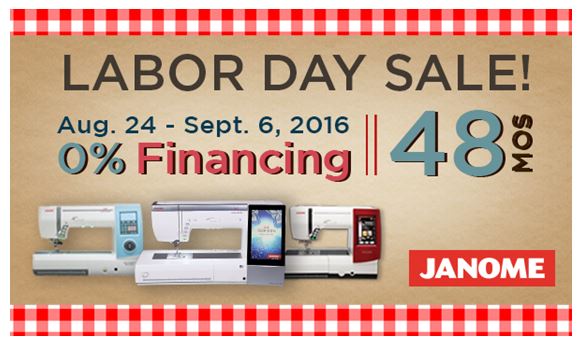
Janome Labor Day Sale

As usual, Janome sent me an ad for their Labor Day Sale.

Janome Labor Day Sale

I don’t know that this is the machine that I actually want, because I haven’t done any real shopping, but if someone sent me one, I wouldn’t say no.

One of these days they won’t have a sale and that will be the time I decide it is time to buy a new machine.

Wearing Out Feet

Well, from the”you learn something new every day department” comes word that you CAN wear out sewing machine feet.

The 9k has been acting up. Not badly, but like an old lady who wants attention. First, something electrical with the light went wrong pretty soon after I brought it home. I know it wasn’t the bulb, because, for a time, if I tapped on it, the light would come on, stay on for a bit, then go out.

I also noticed that the machine would feed the fabric unevenly. I thought I noticed it because I was used to the DC5100, which uses newer technology.

I could live with these annoyances, but when the machine stopped working completely, I was had to do something. One day, I turned it on, the machine made a horrible noise, so I turned it off. Then it wouldn’t turn on again. I swapped it out for the DC5100 since I needed to progress with the Cargo Duffle prep.

Since the machine not turning on was major, I texted Angie at the Sewing Machine Place, though I had avoided it until then despite noting a few issues. She suggested a few things. A different cord worked for making the machine work but she needed to look at it to see what could be done about the feeding and the light. I continued sewing on the DC5100 since I was on a deadline.

The YM and I took it in on Tuesday. I needed him for lugging the 50 lb beast. We found a parking spot right by the door, so I really could have dealt with it myself. She checked everything while I waited. I may have to buy a new power cord, but the old one worked at the shop. The big news was that the feeding problem comes from 20 year old feet.

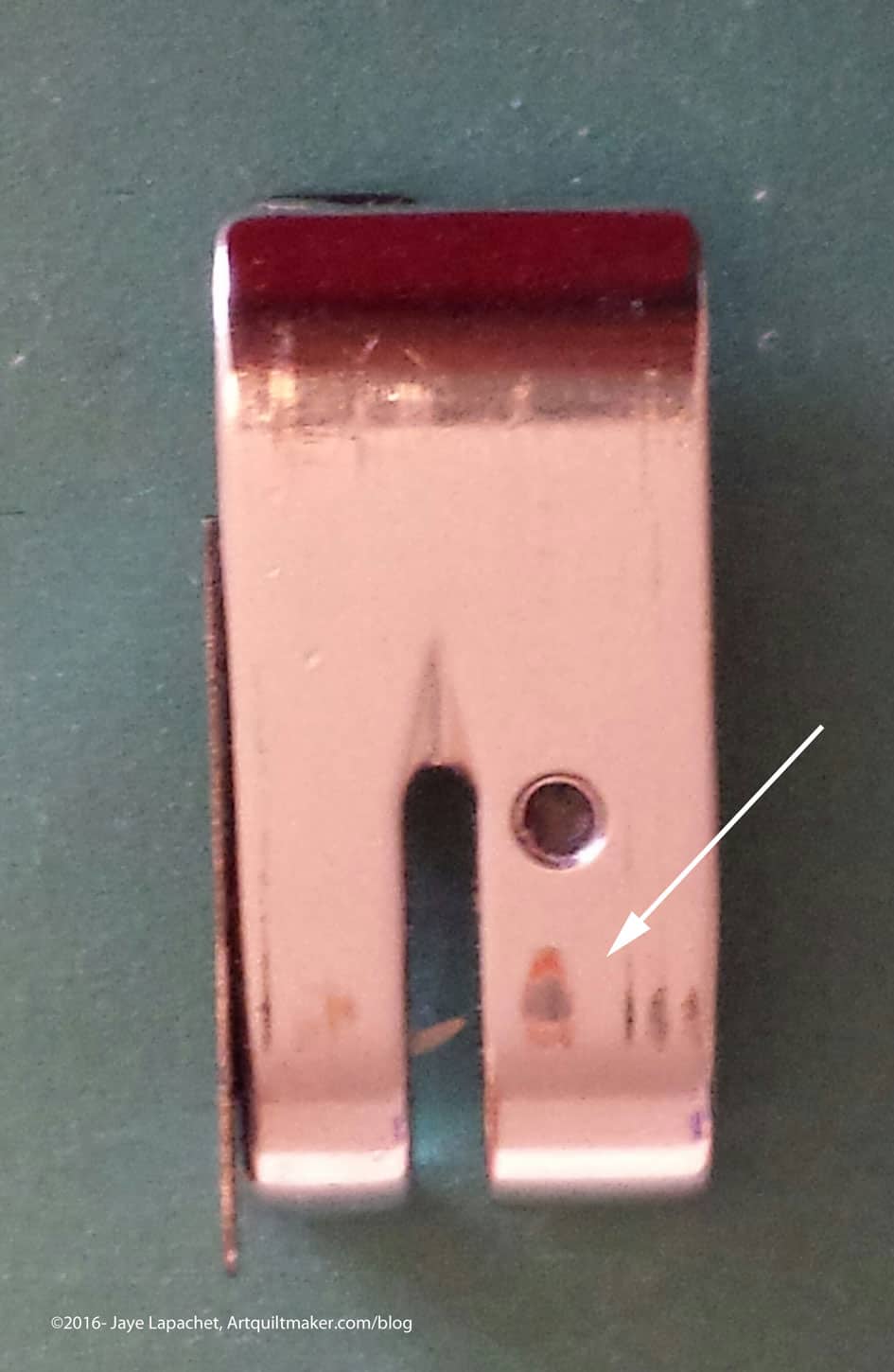
Wear on quarter inch foot

I wore out the two feet I use most frequently. I could not believe what I was hearing. Angie told me that the feet are rubbing up against the feeddogs some of the time, especially the quarter inch foot and that, over time, the metal wears through.

In the photo, you can see the discoloration (I know the photo could be better, but with the glare of the metal the camera had a hard time focusing). That is a spot where at least the first layer is gone.

The foot I use for zig zagging (Janome F) had strips of metal on the plastic bottom and had the same problem. Angie had an F foot so I bought it, but had to go to Always Quilting to get the quarter inch foot. I have been using the DC5100 as I work on the Cargo Duffle so I haven’t had a chance to try out the feeding on the 9k with the new feet. I’ll let you know how it goes.

If you are having feeding problems, check the bottom of your feet.

Janome 9k Returns from the Dead

Yes, I thought the Janome 9000, my first machine and one of Janome’s first electronic machines, was dead. All the evidence pointed to it being dead. After talking to the Sewing Machine Place lady when she serviced my DC5100, as I may have mentioned, I decided to take the 9k in again and see if there was any way I could sew with it again.

Janome 9K back from the shop - June 2016
Janome 9K back from the shop – June 2016

Well, the Janome 9k is back and back in action. I sewed on it all day Saturday from the moment I started to sew until I went to watch Ghostbusters with the family. I know that movie is old, but there are some funny lines in it and we wanted to see it again before we go to see the new one. Also, the YM had never seen it, so it is a good excuse to get him to hang out with us.

Ghostbusters was hilarious. There is good and bad with the machine.

Good

  • I don’t have a machine sitting around that doesn’t work
  • It sews pretty well. It has a good stitch.
  • I have a knee lift to use again!
  • It is quieter than the DC5100
  • Embroidery should work fine. It was calibrated, etc, but I haven’t tried it yet.

Bad

  • $$$
  • It is still an older machine and some of the operations are a little smoother on the newer DC5100
  • The decorative stitches are a little squished
  • It doesn’t feed quite evenly, especially when I start out, but I think it did that before
  • I have to get used to it again
  • There is a strange whooshing sound when I sew. Not loud or annoying, just different.

She couldn’t repair the wear and tear on the machine and I didn’t expect her to. Having this machine back will keep me for awhile. I still want a new machine, though.

More on the Machines

Janome DC5100
Janome DC5100

I decided that being at Grand Parlor was a good time to send my sewing machine to the spa. I wouldn’t have a chance to even think about sewing, which means that it wouldn’t make me crazy to have it gone.

I am not sure it has been serviced since I bought it and I definitely did not buy it with every day use in mind. As you might recall, it was a replacement for the Janome Jem, which I took to classes. Then, I began having irredeemable problems with the Janome 9k and switched to this machine (Janome DC5100) on what I thought was a temporary basis. Here it is a year + later and I am still using it. It was definitely time for a service. I might have had it serviced before, but I don’t think so. Off it went.

No major problems, but when I was on the phone with Angi at the Sewing Machine Place store in Millbrae, she said that she remembered me. I told her about my 9k and she was horrified that she didn’t remember and more horrified that she couldn’t fix it. I didn’t really remember the details, but she asked me to bring it in and see what was up. They don’t charge to look, so I decided I would.

Janome 9000 (9k)
Janome 9000 (9k)

First, I checked the machine myself. It has been sitting since I had problems with it in 2014. Fortunately the cover was on (what do you think I am? A sewing machine torturer?? 😉   ), so there wasn’t much dust. Immediately the problems started. It ran on its own when I tried to thread it using the needle down button. I couldn’t stop it without turning it off. I didn’t do any further testing. I am not be a sewing machine torturer, but I am also not a sewing machine repair person and it has been a long time since I used the 9k. It simply wasn’t familiar to me anymore. 🙁

I finally had some spare time last Wednesday and took it in. I couldn’t find a parking place nearby and had to carry it over a block to get it to the store. I work out, but that baby is heavy.

Angi was selling a machine so her colleague helped me. We went through all the details of the issues I had found and she found that the machine wasn’t feeding either except when it ran by itself. Angi came over when she was done and we had the whole conversation over. She insisted that she would have remembered these problems, but I think I didn’t bring it back, because I thought it was irreparable and I had already been to 3 repair shops. I felt bad because I hadn’t looked up the exact details of what happened last before I went there. I know I took it to three shops including hers, but looked it up by tag later and got some clarity.

Angi looked at the machine and thought that wires had been crossed somewhere along the way, though the problem may stem from something called the step motor. No electronics, which is good since they are hard to come by, if not impossible for a Janome 9k. She thought 2 weeks and ~$300.

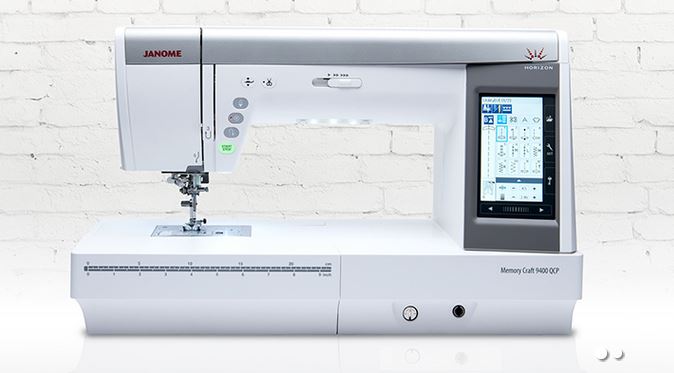
Janome 9400
Janome 9400

I really want a new machine and have my eye on the Janome 9400. However, if I get a new machine with a larger throat, I have to get a new table as well and that adds to the cost. There is really no point in hauling out heavy furniture and bringing new heavy furniture in without painting and generally giving my workroom a facelift. New machine, much less a new table and decor are just not in the cards right now. YM is in college, I am building my business. The finances just don’t work. The other thing is that I fall in love with new Janome machines all the time. Since I have been thinking about new machines, there have been at least 2 others I have wanted. If Angi and her team can get the 9k running again, that will keep me for awhile longer. Cross your fingers.

The Sewing Machine Place
239 Broadway
Millbrae, CA 94030
(650) 697-4739
10:00am-5:00pm (call as hours may vary)

Sewing Machine Final

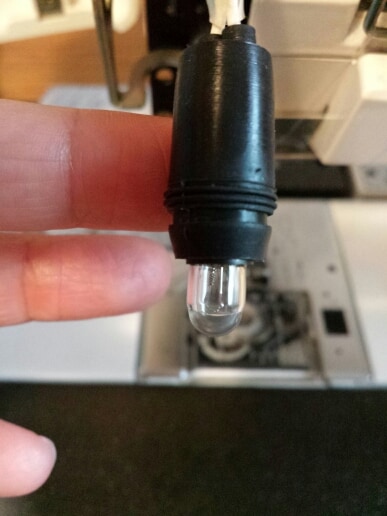
Bulb burned out
Bulb burned out

You probably remember me bringing home the 9k. It worked and I was really happy except that the needle looked out of alignment and the light bulb was burned out.

I called the place that repaired my machine. I felt like an idiot when she, very kindly, told me I could move the needle position.

Oh.

I had never done that before.

Then she explained that she had had to do a factory reset when she re-soldered all of the connections. This meant that the machine was back to what it was like when I bought it. I didn’t remember ever changing the needle position but that was then and this is now. The machine works well. I don’t have to buy a new one; I am happy.

Except for the light bulb. I have an auxiliary bright light over the machine, but it does not shine on the needle. The little sewing I have been doing has been somewhat dark. I asked her about the bulb and she said she would send me one if I told her which one. I was at work; I had no idea.

Later that night I looked at the bulb, which I had to find first. I never had to change the bulb before. That may have been the original bulb! I took a photo and meant to call and tell her, but was too busy at work. My last days mean that projects are being heaped on my that nobody ever thought important before.

On Friday morning I decided I would drive down to the shop and pick up the bulb so I would be ready for sewing on Saturday. When I got there, I showed the photo. The nice lady, Angie, asked if the bulb had two prongs or a roundy sort of connection. I didn’t know. I just stared at her thinking I’d have to go home with no bulb and sew in the dark on Saturday. She gave me one with prongs.

I slotted it in when I got home and turned on the light. It worked and now everyone is happy(mostly me, but also my DH who is happy that I have stopped muttering to myself about incompetent machine repair people and damn light bulbs).

Update: sad news. The machine is on timeout again. I sewed on and off all day on Saturday with my new light bulb, my newly positioned needle and life was good. Sunday all hell broke loose. The machine started running super fast and then giving me an error message about a bent needle or something caught in the needle area.

I changed the needle. No help.

I rethreaded the machine. No improvement.

I rewound a new bobbin. Same problem.

I took off the sole place and cleaned the whole area. It was pretty clean already. Nothing.

I took out the bobbin case and cleaned out under there. The problem persisted, so I put the machine on timeout and took out the backup machine again (no knee lift- BAH).

I feel like I am in an abusive relationship and this might be the last straw. I am going to look and see if there are any contests at which I can win a new machine.

Good News on the Sewing Machine Front

Wednesday

I have a talked a lot about my sewing machine in the recent past and the news has been all bad. 🙁

Finally, last week I got some GOOD news. Finally!

My mom took my machine to Always Quilting for me. I really had nothing to lose since it had been deemed terminal and, perhaps though hope was slim, I could catch a break. I feel like the machine has been at the shop forever.

Anyway, Wednesday I got a call from the woman who was working on it. She wanted to hear the story of the machine.

Huh?

Why would someone want to know the story of my machine? Good idea, but it sounded weird. I think it just sounded weird, because nobody had ever asked me about that before. I told her my whole long sad tale of woe.

She asked if I had noticed skipped stitches or tension problems. I said that I could never get the tension right to free motion quilt, but other than that I wasn’t having any problems. She said that my needle bar was out of alignment. That was a new one on me! I now have a secret hope that I might be able to free motion quilt again sometime. Maybe? Perhaps?

She said that there had been too many hands on the machine and the connections were a mess. She said that a lot of the electronic connections had to be re-soldered, but no new screen was needed and I should have the 9K back by the weekend. I couldn’t believe it!

She said that the machine was NOT terminal!

I feel like I have won the lottery, a reprieve or something really good. I can’t wait to get my machine back.

Sunday

I went and got the machine today. I normally don’t leave, but I am in a weird place with various projects and needed some exercise.

I got the machine back and set it up. First thing I noticed was that the light doesn’t work. Sigh.

The second thing I noticed was that the screen DOES work. YAY!

The needle bar definitely is different. I hope it is straight, though it doesn’t look straight. The seams seem to be straight if a touch wider than a scant 1/4″.

It sounds better, too. I like the sound of my 9k. It is quieter than my other machine.

I will also have a knee lift available again. I haven’t used it yet, but it is set up and ready to go.

My fingers are crossed.

Sewing Machine Saga Continues

After Grand Parlor, I went back to Serge-a-Lot to get my 9k and brought it home, hopefully to use peacefully for the next 5 years.

Sigh.

I turned it on and it sewed great, but the screen was very faint. This machine uses a touch screen and you might remember that, a few years ago, the touch portion stopped working and I had the touch screen replaced. Looking up the dates made me realize that it was over 6 years ago and while the first screen lasted 14 years, perhaps 6 years isn’t too bad for the second screen.

It doesn’t really matter, though, because a new screen cannot be purchased. They are no longer available from Janome.

I am not sure what I am going to do. What I am not going to do is buy is a Janome 15K, which I covet. I have to face reality that I just don’t use the embroidery module. I admire Katie’s “in the hoop” projects, but just don’t think I will do them enough to justify the expense. After all, I don’t have an Etsy store or anything.

A friend had many problems with the Janome 7700 and the reviews have been scalding. That is the type of machine I am looking at, however, if I decide to buy a new machine. I saw a review of the Janome 8900 at Diary of a Sewing Fanatic that got my hopes up for that model. I don’t know if they still make it.

The part of the this whole saga that is really depressing is all the accessories I have for the 9K: Sew Steady table, sewing table insert, hoops, embroidery cards, templates, etc. Bleah!

I have to think about what I want to do.

  • Have you bought a machine recently? What kind?
  • What features do you like on your machine (new or not)
  • What do you really use on your machine?